Why Games Teach Failure Better Than Almost Anything Else
By Xogos Gaming · November 9, 2026 · Games, Curriculum, Life Skills
Turning Mistakes into Confidence, Resilience, and a Love of Learning
Why Does Losing a Game Feel Different From Failing a Test?
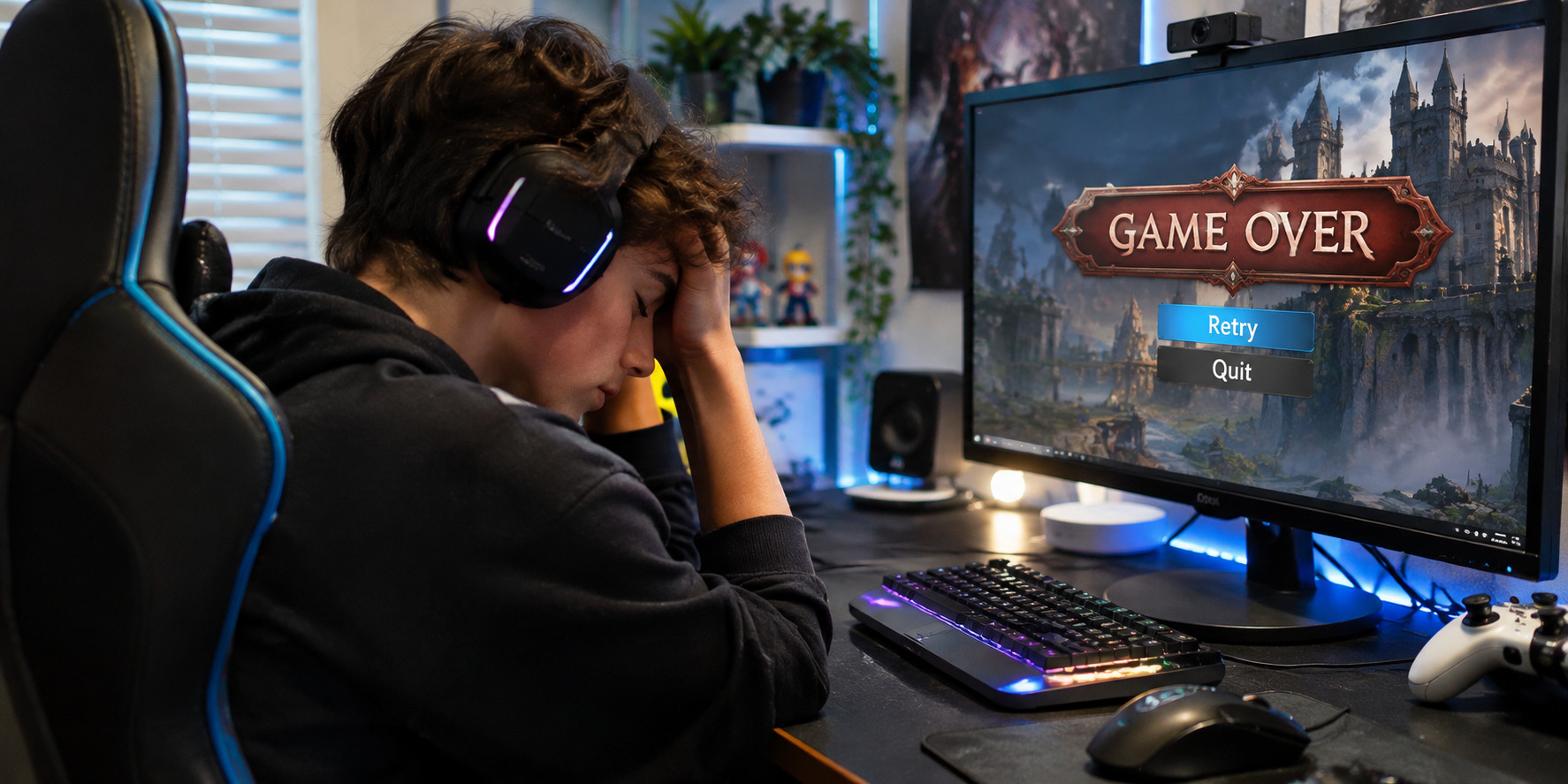
Imagine watching your child play their favorite video game. They spend twenty minutes navigating obstacles, solving puzzles, and defeating opponents. Suddenly, they make one wrong move. Their character loses, and the screen flashes "Game Over." What happens next? They immediately press "Try Again."
Now imagine that same child struggling with a mathematics worksheet. They get several answers wrong, push the paper away, and declare, "I'm terrible at math!" Why can the same child respond to failure in two completely different ways?
The answer involves psychology, motivation, and how we present challenges. Games often make failure feel temporary, while traditional school assignments can sometimes make mistakes feel like judgments of intelligence. What if parents could make academic challenges feel more like video games, where every unsuccessful attempt becomes another opportunity to improve?
The Science of Productive Failure
Educational researchers have discovered that struggling with a problem bef
ore receiving instruction can sometimes produce deeper understanding. Professor Manu Kapur calls this approach productive failure. Instead of immediately providing the correct answer, teachers allow students to experiment, make mistakes, and investigate possible solutions befor
e explaining the underlying concepts.
A 2021 meta-analysis by Kapur and colleagues examined 53 studies comparing problem-solving before instruction with traditional instruction followed by problem-solving. Researchers found a moderate overall learning advantage for the problem-solving-first approach, with a standardized effect size of approximately 0.36.
Imagine a student learning about electricity. Rather than immediately explaining how circuits work, a parent provides a battery, insulated wires, and a small low-voltage bulb. The student experiments with different connections until the bulb illuminates. Their unsuccessful attempts create questions that make the eventual scientific explanation more meaningful.
The important lesson is that failure itself does not guarantee learning. Students need appropriate challenges, helpful guidance, and opportunities to understand their mistakes.
Why Video Games Make Trying Again Exciting
Well-designed video games introduce increasingly difficult challenges while providing immediate feedback. Players discover what went wrong, adjust their strategy, and attempt the challenge again. This creates a powerful learning cycle:
Attempt → Feedback → Adjustment → Another Attempt → Improvement
Interestingly, this process resembles the scientific method. Scientists develop hypotheses, conduct experiments, analyze results, and modify their understanding. Their discoveries often emerge through repeated attempts rather than immediate success.
A 2013 meta-analysis by Pieter Wouters and colleagues, published i
n the Journal of Educational Psychology, examined 77 studies involving educational games. Researchers found that serious games produced better learning outcomes than conventional instruction on average, with a standardized effect size of 0.29 for learning and 0.36 for retention. Benefits were particularly promising when games complemented other teaching methods.
Games are not automatically better than traditional education, but thoughtfully designed games can provide valuable opportunities for experimentation, practice, and improvement.
The Growth Mindset: Teaching Children That Intelligence Can Develop
Psychologist Carol Dweck popularized the concept of a growth mindset: the understanding that abilities can develop through effective strategies, practice, instruction, and support.
A child with a fixed mindset might say, "I'm just not good at science." A growth-oriented response would be, "I haven't figured this out yet."
Parents can reinforce this attitude by praising strategies and improvement rather than simply calling children smart. Instead of saying, "You're a genius!" try, "You discovered why your first strategy didn't work and found a better solution!"
Research suggests that growth-mindset interventions have varying results, so encouragement must be combined with effective teaching. Children need to experience real improvement, not simply be told to believe in themselves.
Five Ways Parents Can Make Failure Part of Learning
1. Turn Mistakes Into Detective Challenges. When students answer questions incorrectly, ask them to investigate what went wrong before providing the solution. Let them become detectives searching for missing clues. Encourage them to explain their corrected answers.
2. Create a Family Failure Challenge. Once a week, have everyone share something they attempted that didn't work and what they learned from the experience. When children see parents making mistakes and trying again, failure becomes a normal part of life.
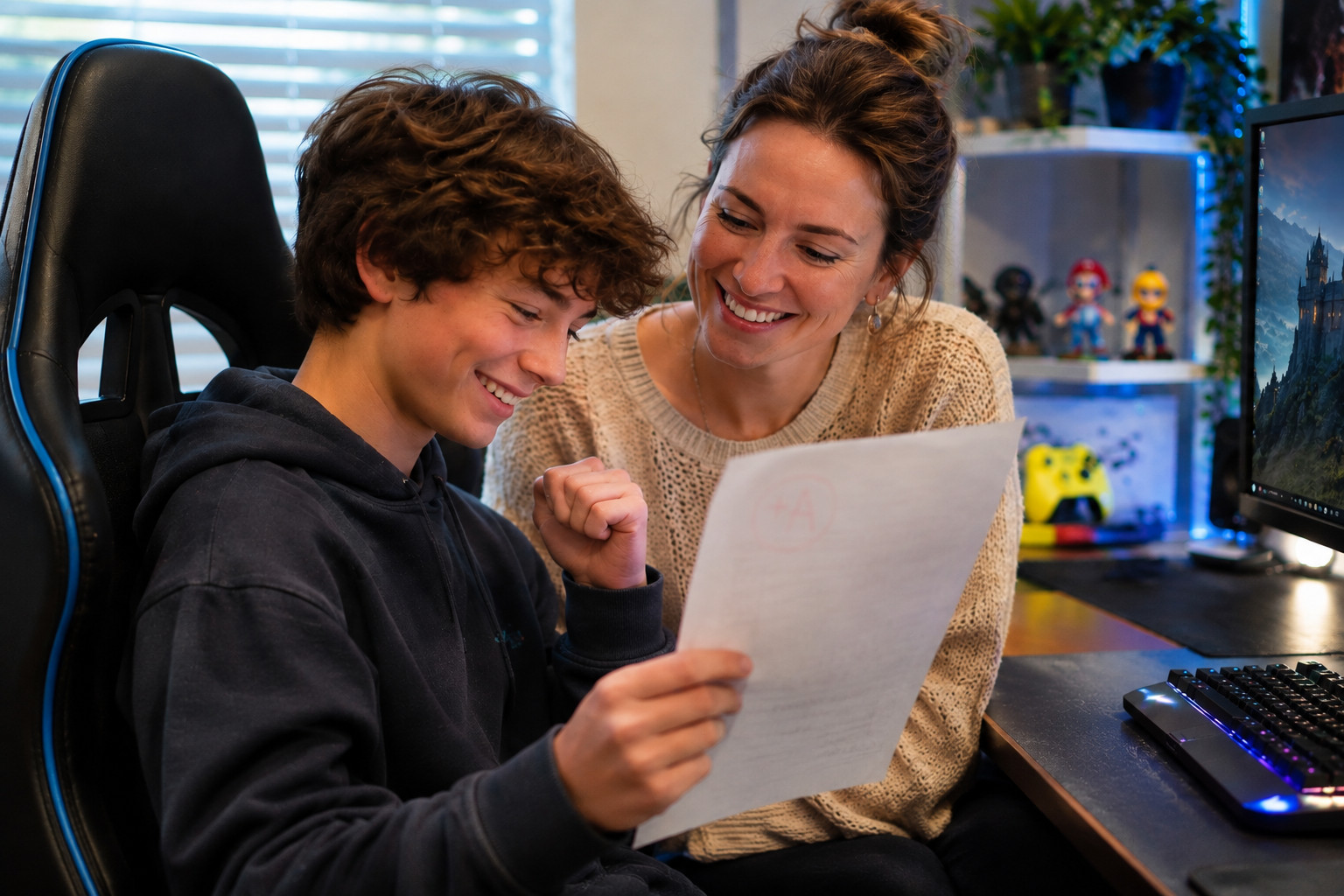
3. Turn Assignments Into Game Levels. Divide a mathematics or science assignment into increasingly challenging levels. Allow students to retry difficult problems, earn progress markers, and celebrate improvements rather than simply rewarding perfect scores.
4. Celebrate Unexpected Science Results. Conduct simple experiments involving plants, water, magnets, or electricity. When results differ from predictions, encourage students to investigate why. Teach them that unexpected results can lead to important discoveries.
5. Let Students Teach Their Mistakes. After overcoming a difficult problem, have children explain what they initially misunderstood and how they eventually succeeded. Teaching others helps students organize their thoughts, recognize progress, and reinforce understanding.
Knowing When to Help
Although challenges can strengthen learning, too much frustration can have the opposite effect. Parents should recognize when a student needs a hint, a simpler explanation, or a short break. Productive failure is not about leaving children confused or discouraged. It is about giving them opportunities to discover solutions while knowing support is available.
Every child approaches challenges differently. Some enjoy competition, while others prefer cooperation. The goal is not to make children love losing but to help them understand that mistakes do not define their abilities.
Bringing the Adventure of Learning to Xogos Gaming
At Xogos Gaming, we believe students should have opportunities to explore, experiment, make decisions, and learn from their mistakes in engaging educational environments, especially in a digital format. Through www.XogosGaming.com, students can experience educational games and free elective classes covering history, science, mathematics, geography, personal finance, and other academic subjects.
Imagine a student playing a historical strategy game, losing a battle, and reconsidering their decisions. Another student might explore a medical simulation, make an incorrect diagnosis, investigate the evidence, and try again. A young entrepreneur could make an unsuccessful financial decision in a business simulation and discover how to improve their strategy.
These experiences can help students practice problem-solving in environments where mistakes become opportunities to learn. Our goal is to encourage students to carry that same determination beyond the screen and into their schoolwork, families, communities, and future careers.
The next time your child struggles with an assignment or loses a game, remember that the most valuable lesson may not be getting the answer right. It may be discovering that failure is not the end of learning—it is often where learning begins.