SAT, ACT or CLT? A Texas Homeschooler's Guide to Choosing (and Paying for) the Right Test
By Achievable Inc · November 13, 2026
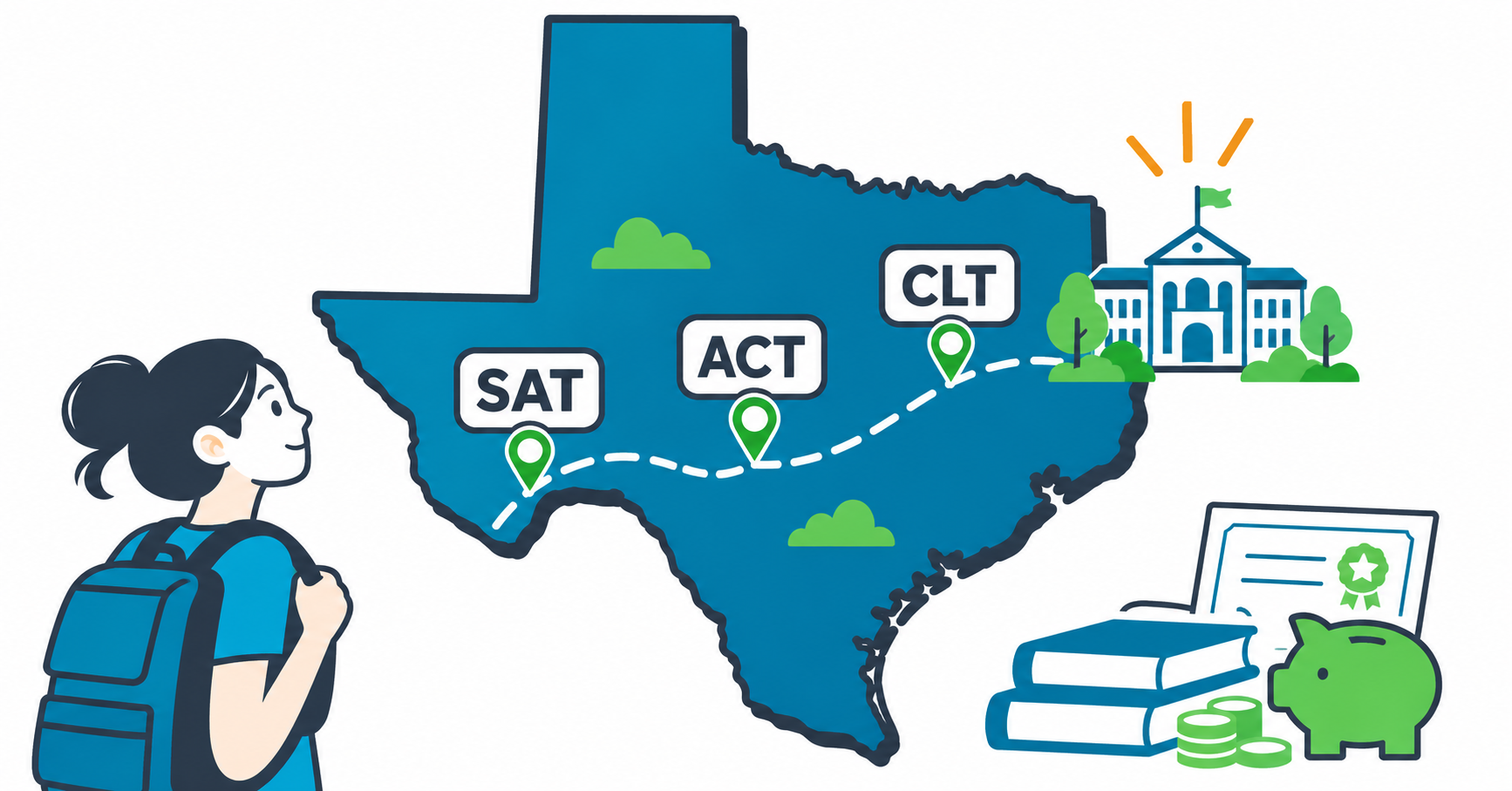
When a homeschooled student applies to college, the admissions office is missing most of what it usually relies on. There's no school profile and no guidance counselor letter, and the transcript was written by a parent. Your student's application can be excellent, but the one number a college can compare directly with every other applicant is the test score.
For Texas homeschool families, that's literally true. Here's what the score does for your student, how to choose between the SAT, ACT and CLT, and how to use your Texas Education Freedom Account (TEFA) to pay for prep.
In Texas, the test score works like a class rank
Texas public universities automatically admit students who graduate near the top of their high school class. Homeschoolers don't have a class rank, so Texas law ranks them by standardized test scores instead.
A 2025 state law, House Bill 3041, tightened this for UT Austin. The university now sets a test-score benchmark for homeschool applicants, designed so that they're admitted automatically at the same rate as traditionally schooled students. For freshmen entering in Spring 2027 through Spring 2028, UT Austin automatically admits homeschool graduates with an SAT score of 1570 or higher or an ACT score of 36.
That bar is very high, and most students will be admitted through UT's regular holistic review instead. Even there, the score carries extra weight for a homeschooler, because so much of the rest of the application can't be compared with other applicants.
The national trend points the same way. In the 2025–26 admissions cycle, more Common App applicants reported a test score than applied test-optional, for the first time since the pandemic. A growing list of colleges, UT Austin included, has brought back required scores.
The takeaway: even if your student's target schools are test-optional, plan for at least one strong score.
How the three tests differ
The SAT has two sections, Reading and Writing and Math, and takes 2 hours 14 minutes. It's fully digital and adaptive, so the second module of each section gets harder or easier depending on how the first went. The math leans heavily on algebra, the reading passages are short, and virtually every U.S. college accepts it.
The ACT covers English, Math and Reading, with optional Science and Writing sections, and takes 2 hours 5 minutes without Science. It's mostly given on paper, though digital testing is expanding. It moves faster than the SAT, with less time per question, so it rewards students who read quickly and stay calm under time pressure. The optional Science section is really about reading charts and data, not memorizing facts. Like the SAT, it's accepted virtually everywhere.
The CLT was built for students from classical and faith-based programs. Its three sections, Verbal Reasoning, Grammar/Writing and Quantitative Reasoning, take 2 hours. Its reading passages come from classic literature and philosophy, and it puts heavy weight on logic and reasoning. It's mostly digital, and it's the only one of the three that can be taken at home. It's a natural fit for many homeschool families, but it's accepted mainly by private, religious and classical colleges, plus the U.S. military service academies. UT Austin's automatic-admission benchmark, for example, is set in SAT and ACT scores.
How to choose
- Start with your college list. If your student is applying to Texas public universities or highly selective schools, choose the SAT or ACT. If the list is mostly classical or Christian colleges that accept the CLT, the CLT may be the more natural test.
- Match the test to how your student learns. Strong readers who like logic and classic texts often do well on the CLT. Students who work quickly and like clearly separated subjects often prefer the ACT. Students who'd rather have more time per question, and who are comfortable with algebra, often prefer the SAT.
- Take a timed practice test of each finalist. Do it before studying, so the result shows your student's natural fit rather than their preparation. Then compare the results with a concordance table. A CLT score of 80–99 is roughly an SAT score of 1170–1380, or an ACT score of 24–30.
- Pick one and commit. Splitting prep time between two tests usually produces two mediocre scores instead of one strong one.
If you'd like a shortcut, Achievable's free Which exam should I take? quiz asks 10 questions about reading speed, math level and pacing and recommends a test.
A testing timeline for homeschool families
- Grades 9–10: Build the foundations through strong reading, Algebra I, geometry and steady writing practice. No formal test prep is needed yet.
- Fall of 11th grade: Take diagnostic practice tests, choose the test, and start a study plan of a few hours a week.
- Spring of 11th grade: Take the real test for the first time.
- Summer and fall of 12th grade: Retake once or twice if needed. Many colleges superscore, combining a student's best section scores across test dates, so a retake rarely hurts.
Homeschoolers register just like any other student. For the SAT and ACT, you'll choose a test center and enter a homeschool code instead of a high school code. For the CLT, you can choose the at-home option. Register early, because seats at test centers near you can fill up.
Paying for prep with TEFA
Texas Education Freedom Accounts give homeschool students up to
Achievable is an approved TEFA vendor. Our SAT, ACT and CLT courses are each $99 for a full year of access, which is a small share of a homeschooler's yearly TEFA funds. Each course includes:
- A self-paced online textbook written in plain English, with an adaptive study planner that works around your homeschool schedule
- Hundreds of practice questions with full explanations, plus math practice that generates new numbers every time
- Full-length, timed practice exams
- An AI tutor that answers questions as your student studies
- A score guarantee: up to 120 more points on the SAT, 6 on the ACT or 15 on the CLT, depending on where your student starts, or your money back
Our CLT course was created with Clayborne Education, the CLT's official test prep provider. The first lessons of every course are free, with no credit card needed, so your student can try one before you spend any TEFA funds.
Because the courses are self-paced, they fit the way homeschool families already learn. Your student can study at the kitchen table in October or on a phone during a road trip in June.
The bottom line
For a Texas homeschooler, the SAT, ACT or CLT isn't just one part of the application. It's the closest thing to a class rank that colleges will see, and at UT Austin it can decide automatic admission. Choose the test that fits your student's college list and strengths, start in 11th grade, and use your TEFA funds to make good prep affordable.
Achievable offers online SAT, ACT and CLT prep for students and families, available through TEFA. Learn more at achievable.me.